Superelevation Transition Explained: From Normal Crown to Full Super in Highway Design
Designing safe, smooth, and comfortable road curves is a cornerstone of modern highway engineering. When vehicles navigate horizontal curves at higher speeds, centrifugal force pushes them outward, increasing the risk of skidding or rollover. To counter this, engineers apply superelevation — the gradual tilting of the roadway surface toward the curve’s interior.
Superelevation is not applied abruptly. It follows a carefully designed transition sequence, moving from a normal crown to full superelevation and back again. Understanding each stage of this transition is critical for highway engineers, CAD designers, and Civil 3D modelers. In this guide, we break down the superelevation transition process, explain each critical station, and detail how pavement assemblies change step-by-step during transitions.
What Is Superelevation?
Superelevation is the rotation of the pavement surface on a horizontal curve where the outer edge is raised relative to the inner edge. Its primary purposes include reducing lateral friction demand, enhancing vehicle stability on curves, improving driver comfort, ensuring proper drainage, and increasing safety at design speeds.
Superelevation is usually expressed as a percentage, depending on road classification, design speed, and local highway standards, such as 2% for low-speed roads, 4% for standard highways, 6% for high-speed highway curves, and 8% for mountainous or tight-radius curves.
Understanding Superelevation Transition
A roadway cannot instantly change from a normal crown to a fully superelevated cross-section. Abrupt transitions cause driver discomfort, uneven pavement stress, and unsafe geometric conditions.
Instead, the pavement rotates gradually through a series of transition stations, each with a specific purpose. A typical superelevation transition includes the Transition In Region, the Full Super Section, and the Transition Out Region. During these regions, lane and shoulder slopes change progressively, ensuring smooth ride quality, proper drainage, and vehicle stability. also check Roundabout Corridor Regions & Assemblies.
Normal Crown Condition
Before superelevation begins, the road has a normal crown, designed to drain water efficiently. Typical slopes are lanes at −2% and shoulders at −5%. The normal crown ensures water flows away from the centerline toward edges and provides proper drainage on tangent sections.
Critical Stations in Superelevation Transition
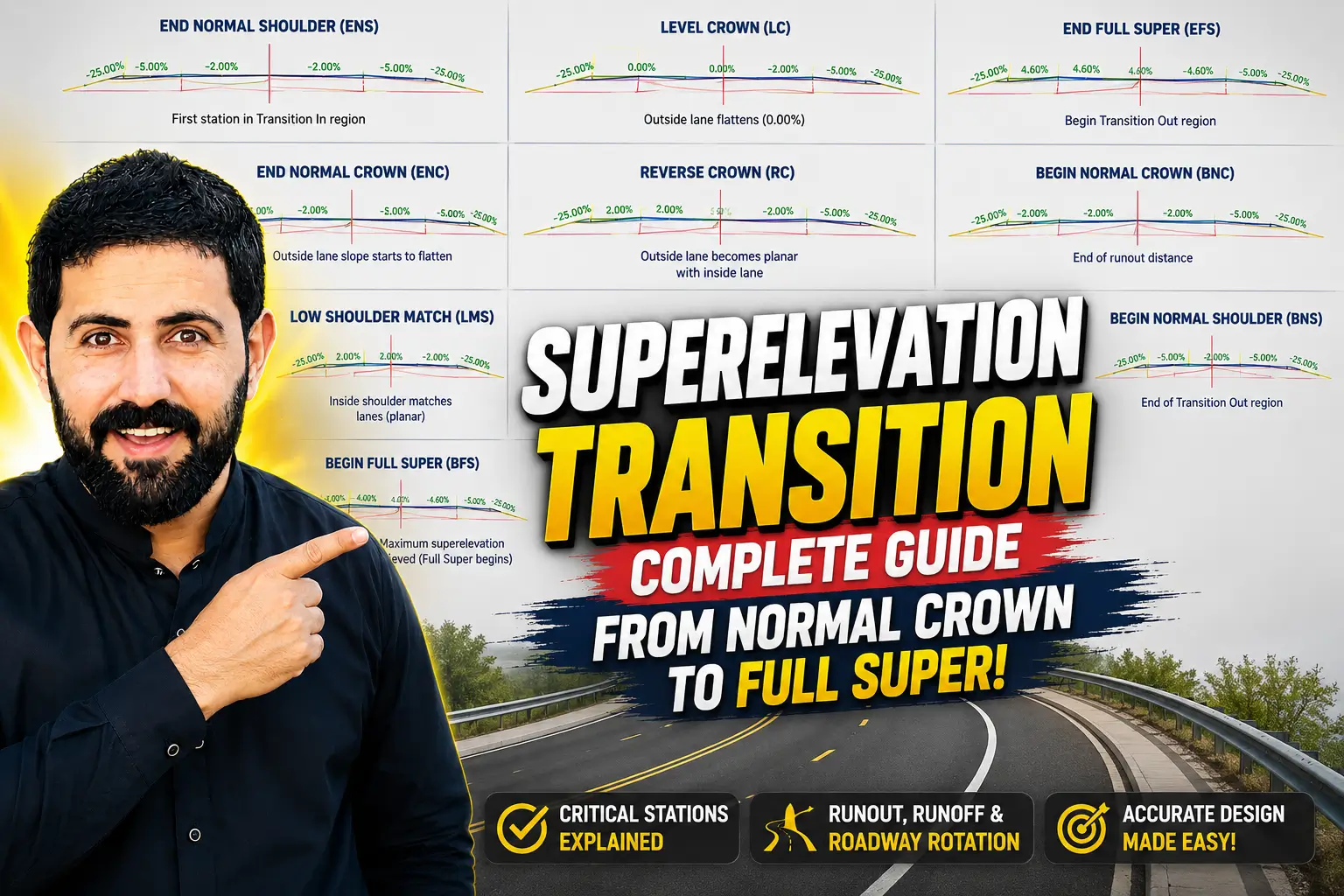
The superelevation transition is governed by several critical stations, marking milestones in pavement rotation.
1. End Normal Shoulder (ENS)
- Marks the start of Transition In
- Lane and shoulder slopes remain normal
- Inside shoulder begins gradual rotation
Purpose: ENS signals the start of shoulder rotation, initiating the superelevation process.
2. End Normal Crown (ENC)
- Normal lane crown still exists
- Outside lane starts flattening
- Runoff transition begins
Observation: Outside lane slope moves toward 0%, signaling the end of normal crown behavior.
3. Level Crown (LC)
- One side of the roadway is flat
- Cross slope reaches 0%
- Acts as the midpoint between normal and reverse crown
Importance: LC marks the start of runoff distance and the end of certain runout operations. Occurs in both Transition In and Transition Out regions.
4. Reverse Crown (RC)
- Pavement rotates inward toward curve interior
- Outside lane slopes align with inside lane
- Roadway crosses from normal crown to superelevation behavior
Significance: RC signals the full engagement of superelevation forces, critical for high-speed curve design.
5. Low Shoulder Match (LMS)
- Inside shoulder becomes planar with lanes
- Shoulder and lane slopes are aligned
Importance: Ensures drainage continuity, better vehicle recovery, and pavement edge stability.
6. Begin Full Super (BFS)
- Marks the end of Transition In
- Both lanes fully planar at maximum superelevation (e.g., 6%)
Engineering Note: BFS is the first point where the road operates at full design superelevation, optimizing vehicle stability.
Full Super Section
Between BFS and EFS, cross slope remains uniform, vehicle operation is stable, and centrifugal force is fully compensated. This section spans the central portion of the horizontal curve and ensures smooth driving at design speeds.
7. End Full Super (EFS)
- Full super ends
- Runoff removal begins
- Cross slopes start returning to normal crown
Purpose: Initiates the Transition Out region.
8. Begin Normal Crown (BNC)
- Cross slope approaches tangent conditions
- Runout distance ends
- Pavement rotation nears completion
Observation: Roadway almost returns to standard tangent geometry.
9. Begin Normal Shoulder (BNS)
- Shoulders return to normal slope
- Standard crown is restored
- Transition Out ends
Significance: Roadway now fully matches tangent section geometry.
Understanding Runout and Runoff
Runout: Distance required to remove adverse crown from outside lane before full superelevation.
Runoff: Distance needed to rotate pavement from zero slope to full superelevation; majority of pavement rotation occurs here.
Both are critical for smooth superelevation application, ensuring proper drainage, ride comfort, and safe curvature.
Applying Superelevation in Autodesk Civil 3D
Civil 3D automates superelevation transition modeling using alignment geometry, design speed criteria, lane rotation settings, superelevation wizard, and critical station calculations. It calculates ENS, ENC, LC, RC, LMS, BFS, EFS, BNC, BNS based on highway design standards and dynamically updates corridor assemblies.
Why Smooth Superelevation Transition Is Critical
Poorly designed transitions can cause driver discomfort, drainage issues, water ponding, vehicle instability, and pavement edge stress. Smooth transitions ensure safer curve negotiation, better ride quality, improved drainage, and accurate roadway modeling.
Practical Design Considerations
When designing superelevation transitions, consider design speed, drainage, terrain constraints, and vehicle behavior. Common mistakes include sudden slope changes, ignoring shoulder alignment, misplacing critical stations, and poor drainage planning. Following highway design standards ensures realistic, safe, and constructible superelevation models.
Final Thoughts
Superelevation is more than tilting a road; it’s a precise engineering process. Understanding each critical station ENS, ENC, LC, RC, LMS, BFS, EFS, BNC, BNS enables engineers and Civil 3D designers to produce safe, smooth, and constructible highway corridors. Properly applied, it improves safety, drainage, ride comfort, and overall roadway performance. Mastery of superelevation transitions is essential for professional highway design and modern corridor modeling. for more training and projects keep on visiting us.